Home
About us
Destinations & Country Guides
Travel Guides
Recipes
Featured
Photos As Art
Abstract Prints
Locations
Travel Gear
Travel Resources
Favorites
Photo Framer
Explore Photos
Contact Seasonal travel
By Clever Tourists · Published · Last updated
Munich's Krampuslauf in 2026 is on Sunday 13 December, the third Sunday of Advent, from 15:00 to 17:00, according to the City of Munich. It is free, it starts at Augustinerstraße by the Frauenplatz and it ends in front of the Old Town Hall on Marienplatz. It is not on St Nicholas Day itself. St Nicholas Day (Nikolaustag) is 6 December, which in 2026 is a Sunday, and in Bavaria it is mostly a family and church custom: children put out their boots on the evening of the 5th and St Nicholas visits, sometimes with a Krampus at his side. The big public parade is Munich's, a week later. We spent 5 days in Munich in July 2023, so this page gives the 2026 dates and routes from the city and the organisers, not memories of an Advent we did not spend there.
St Nicholas Day is a Catholic feast for Nicholas of Myra, the fourth-century bishop who became the gift-bringer of the Alpine and German-speaking world. In Germany it is a church feast day, not a public holiday, so shops follow normal rules (and on Sunday 6 December 2026 they are shut anyway, as on every German Sunday).
The custom most families keep is simple: children clean their boots and put them outside the door on the evening of 5 December, and in the morning they find small gifts such as chocolate, tangerines, nuts and biscuits. In Catholic Bavaria, St Nicholas may also visit in person in bishop's robes, sometimes with a dark companion who scolds the children who have misbehaved.
That companion is the Krampus: a horned, furred figure with a carved wooden mask, cowbells and a switch of birch twigs. The City of Munich's page describes three types you will see in the parade:
• Krampus: the dark companion of St Nicholas.
• Perchten: figures with four to ten horns which, in the older tradition, drove out winter. They now join Advent runs alongside the Krampus.
• Klausen: the Nicholas figures of parts of the Alps.
The city puts the age of these runs in the Alpine region at about 500 years. Munich's own Krampuslauf is much newer: the first one was on 12 December 2004, with about 100 figures.
The details below come from the City of Munich (muenchen.de) and the official Christkindlmarkt site, both updated for 2026.
• Date and time: Sunday 13 December 2026, 15:00 to 17:00. The organisers stress that it starts on the dot at 15:00.
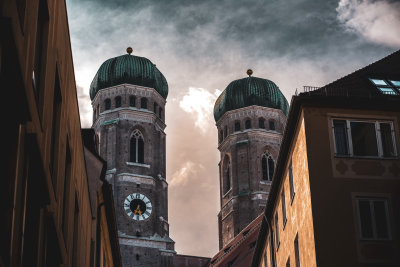
• Start: the groups line up in Augustinerstraße, by the Frauenplatz in front of the Frauenkirche.
• Route: through the pedestrian zone via Kaufingerstraße, Färbergraben, Rosental, Sendlinger Straße, Dultstraße, Oberanger and Rindermarkt, then over Petersplatz to the Viktualienmarkt. The organisers say the route has changed slightly this year, so do not rely on older maps.
• Finish: in front of the Altes Rathaus (Old Town Hall) at the eastern end of Marienplatz.
• Who takes part: about 25 groups with more than 300 Krampusse, Perchten and Klausen, from Bavaria, the Allgäu, Salzburg, Tyrol, South Tyrol, Styria and Carinthia. The host group is Munich's Sparifankerl-Pass, and the city's Department of Labour and Economic Affairs organises and pays for the event. St Nicholas traditionally closes the parade.
• Cost: free; you just stand along the route.
• Crowds: the official market site expects up to 50,000 spectators.
The Christkindlmarkt on Marienplatz runs from 20 November to 24 December 2026 and stays open until 20:00 on Sundays, so there is time for a mulled wine afterwards. Our German Christmas markets guide has the other cities' dates.
Pick a spot and stay there. The city advises watching from one place rather than walking alongside, because the full procession takes a while to pass. The narrower streets (Rosental, Sendlinger Straße, Dultstraße) put you closest to the figures. The finish at the Old Town Hall is the most crowded. Arrive by 14:15 or so for the front row anywhere on the route.
What actually happens. Figures run, stamp and ring their bells. They interact with the crowd: the official site says hats may be snatched briefly but are given back, and most groups stop for photos. The city's own line is that the figures look far more frightening than they are, and that you may look at and touch them.
Children. Many local children watch from the front row and love it. The city also notes that the noise and size can overwhelm very young children, and suggests families with small children stand further back. A sensible plan for toddlers: watch from the back of the crowd near Petersplatz, where you can step away into the Viktualienmarkt if it gets too much.
Safety and etiquette. The masks weigh up to about 10 kg and participants often get out of breath, so do not grab masks, horns or switches, and do not follow figures for a selfie. Keep a hand on bags in the crush around Marienplatz; pickpockets work big Advent crowds in every European city. Leave dogs at home.
Getting there. Marienplatz is the central U-Bahn and S-Bahn stop; Karlsplatz (Stachus) and Sendlinger Tor are useful alternatives when Marienplatz is packed. For areas to stay, see where to stay in Munich.
If you want the older, village version, the Berchtesgaden area in the far south-east of Bavaria is the best-documented. According to the Berchtesgaden tourist office, figures in fur and straw called Buttnmandl and Kramperl go around the villages with St Nicholas. Its published pattern is:
• First Sunday of Advent (29 November in 2026): a Buttnmandl run in Loipl.
• Second Sunday of Advent (6 December in 2026): a run in Winkl.
• 5 December, after dark: visits in many villages across the Berchtesgadener Land.
• 5 December: the Bundeswehr St Nicholas procession, held since 1962, from the mountain infantry barracks in Strub/Bischofswiesen into Berchtesgaden, with Buttnmandl, Kramperl and angels. This is the public one that draws spectators.
• Christmas Eve afternoon: a run in Maria Gern.
The tourist office is clear that most of this is a private tradition, with families visited at home, not a show. Watch from the roadside, do not follow groups to houses, and ask before photographing anyone without a mask. It had not published 2026 times when we checked, so confirm with the Berchtesgaden tourist information before you travel.
Many more Krampus and Perchten runs take place just over the border in Salzburg and Tyrol, which is where most of Munich's guest groups come from. Our day trips from Munich guide covers the rail links south.
With the parade on Sunday 13 December, a Friday-to-Sunday trip works well: markets on Friday and Saturday, the Krampuslauf on Sunday afternoon. Remember that shops in Germany are closed on Sundays, though the Christkindlmarkt itself opens.
Book central hotels early for that weekend; Advent Saturdays are the busiest days at Munich's markets. Munich is also an easy base for a wider loop: see our Europe Christmas markets planner and, for the food at the stalls and beyond, what to eat in Munich.
For the city itself, our Munich guide covers the sights, and how many days in Munich helps size the trip.
Sunday 13 December 2026, from 15:00 to 17:00, according to the City of Munich. It starts in Augustinerstraße by the Frauenplatz and ends in front of the Old Town Hall on Marienplatz. Entry is free.
Not in Munich. St Nicholas Day is 6 December, but Munich holds its Krampuslauf on the third Sunday of Advent, which is 13 December in 2026. In the Berchtesgaden area, village customs centre on 5 December and the Advent Sundays.
Many local children watch from the front row, and the figures are harmless. The city notes the noise and size can overwhelm very young children and suggests families with toddlers stand further back.
No. It is a church feast day, not a public holiday. In 2026 it falls on a Sunday, when German shops are closed anyway.
Get our new Munich guides and practical tips by email: where to stay, what to eat, what things cost and the rules that catch travelers out.
Free. No spam, only new guides and tips.
Search verified local fleets with low security deposits and exact model delivery on Localrent.
Best deals on Munich hotels this week — check Booking.com.