Home
About us
Destinations & Country Guides
Travel Guides
Recipes
Featured
Photos As Art
Abstract Prints
Locations
Travel Gear
Travel Resources
Favorites
Photo Framer
Explore Photos
Contact Attractions & day trips
By Clever Tourists · Published
Szentendre, Esztergom and Eger are the three best day trips from Budapest, and all three are a direct train ride away. Szentendre is about 40 minutes up the Danube on the suburban HÉV; Esztergom's basilica and the river border with Slovakia are about an hour by train; Eger, with its castle and wine cellars, is just under 2 hours. We spent 5 days in Budapest in October 2022, arriving from Brno, then went on to Eger for 3 nights and Tokaj for 3, so Eger was a stop for us rather than a day trip. Vienna works in a day by train, but only just.
Ranked by payoff against time on the train:
• Szentendre: about 40 minutes on HÉV line H5. Half a day.
• Esztergom: about 65 minutes by direct train from Nyugati. A full day with Štúrovo across the bridge.
• Visegrád: 40 to 60 minutes by train to Nagymaros, then the ferry. A full day.
• Eger: about 1 hour 50 minutes to 2 hours by direct train from Keleti. A full day, better overnight.
• Gödöllő Royal Palace: about 45 to 50 minutes on HÉV line H8 from Örs vezér tere. Half a day.
• Lake Balaton (Balatonfüred): about 2 hours by train. A summer day.
• Vienna: about 2 hours 40 minutes by Railjet. Better overnight.
Budapest itself needs at least 3 days before you start on these; our 3 days in Budapest itinerary covers Castle Hill, the Parliament, the Jewish Quarter and the baths.
What it is: a small riverside town of painted houses, Serbian Orthodox church towers and cobbled lanes climbing from the main square, settled by Serbian refugees and later an artists' colony. It has more small galleries and museums than its size suggests.
Getting there: HÉV line H5 from Batthyány tér runs every 10 to 20 minutes and takes about 40 minutes to the terminus. A Budapest ticket or pass only covers the line to the city boundary, so buy the extension ticket for the stretch beyond it, or BKK's suburban railway tour ticket, before you board.
How long: 3 to 4 hours. Who it suits: an easy half day, and the best choice if you only have one spare afternoon. Tip: go on a weekday morning; at weekends the main square and Bogdányi utca fill with visitors from the city. Check BKK for weekend works on the H5, which sometimes put replacement buses on the outer section.
What it is: Hungary's first royal seat and the center of its Catholic church, dominated by the Esztergom Basilica on Castle Hill above the river, the largest church in the country. Below it, the Mária Valéria Bridge crosses the Danube to Štúrovo in Slovakia.
Getting there: direct trains from Budapest-Nyugati take about 65 minutes and run at least hourly. Buses from Árpád híd take about 1 hour 20 minutes and pass along the river.
How long: a full day. Who it suits: churches, views, and anyone who wants a second country in a day. Tip: climb the basilica dome in the morning, then walk across the bridge to Slovakia in the afternoon for the best view back at the basilica. Both countries are in Schengen, but carry your passport.

What it is: the point where the Danube swings south through wooded hills, with the ruins of a royal palace by the river and a hilltop citadel above Visegrád giving the classic view of the bend.
Getting there: there is no train station in Visegrád itself. Trains from Nyugati reach Nagymaros-Visegrád on the opposite bank in about 40 minutes to an hour, and a ferry crosses roughly hourly from a dock about five minutes' walk from the station. In season, river boats also run from Budapest; check the current Mahart timetable.
How long: a full day. Who it suits: walkers and anyone who prefers views to museums. Tip: the citadel is a steep climb from the riverside, so plan the ferry times around it. Visegrád, Szentendre and Esztergom can be strung together by car in one day, but not comfortably by public transport.
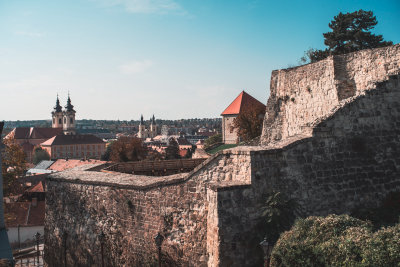
What it is: a baroque wine town built around the fortress that held off an Ottoman army in 1552, with the northernmost surviving Ottoman minaret in Europe and the Valley of the Beautiful Women, about 200 cellars cut into the hillside, pouring Egri Bikavér. Our Eger guide covers each of them.
Getting there: direct trains from Budapest-Keleti take about 1 hour 50 minutes to 2 hours and run roughly hourly. Tickets are cheap, and can be bought in advance on the MÁV app.
How long: a full day at the very least. Who it suits: wine, history and anyone heading east. Tip: do it as an overnight if you can. The cellars are a 15-minute walk from the center and the best part of Eger is the evening there, which a day trip cuts short. We spent 3 nights in Eger straight after Budapest and then continued to the Tokaj wine region.
Gödöllő Royal Palace: one of the largest baroque palaces in Hungary and Empress Elisabeth's (Sisi's) favourite retreat. Take the M2 metro to Örs vezér tere, then HÉV line H8 for about 45 to 50 minutes to Gödöllő Erzsébet park, a short walk from the gates. Half a day; check opening days before you go, as listings disagree.
Lake Balaton: central Europe's largest lake, with Balatonfüred and the Tihany peninsula on the north shore. Trains to Balatonfüred take about 2 hours. Worth it from June to early September for swimming; outside summer many lakeside places close.
Vienna: ÖBB Railjets run every one to two hours from Keleti and take about 2 hours 40 minutes. That leaves about 6 hours in Vienna, enough for the Ringstrasse and one palace or museum. It is a capital city that deserves at least two nights; a day trip is a sampler, not a visit.
Which station: Nyugati for Esztergom and Nagymaros-Visegrád, Keleti for Eger and Vienna, Batthyány tér for the Szentendre HÉV and Örs vezér tere for the Gödöllő HÉV. Most of the Balaton trains leave from Déli. Check the station on your ticket the night before.
Where to stay for day trips: anywhere near the M2 or M3 metro makes early starts easy; our where to stay in Budapest article compares the districts.
Season: we were in Budapest in early October, which is a good month for the Danube Bend and Eger, with the summer crowds gone. In winter, shorten the river days and spend the afternoons in the thermal baths instead; from late November the Christmas markets are the evening plan.
Food and money: Hungary uses the forint, not the euro, so carry some forint cash for small cellars and museum kiosks. Before you go, see tipping in Budapest and our Hungarian food guide.
Szentendre for a short trip, about 40 minutes on HÉV line H5. For a full day, Esztergom by direct train in about 65 minutes, or Eger in just under 2 hours.
Esztergom from Nyugati (about 65 minutes), Nagymaros-Visegrád from Nyugati (40 to 60 minutes plus the ferry), Eger from Keleti (about 1 hour 50 minutes to 2 hours) and Szentendre by HÉV (about 40 minutes).
Yes, but it is better overnight. The direct train takes just under 2 hours, and the wine cellars of the Valley of the Beautiful Women are at their best in the evening. We spent 3 nights there.
Yes, Railjets take about 2 hours 40 minutes each way and run every one to two hours, which leaves about 6 hours in Vienna. It deserves at least two nights if you can spare them.
Take the train from Nyugati to Nagymaros-Visegrád, about 40 minutes to an hour, then the roughly hourly ferry across the Danube. There is no station in Visegrád itself.
Get our new Hungary guides and practical tips by email: where to stay, what to eat, what things cost and the rules that catch travelers out.
Free. No spam, only new guides and tips.
Search verified local fleets with low security deposits and exact model delivery on Localrent.
Get the best deals on your Hungary flight before fares rise — Kiwi.com.